





Irina Gabiani | EVERY OBJECT IN THE SKY LOOKS LIKE A STAR
From 21/05/2026 To 05/09/2026
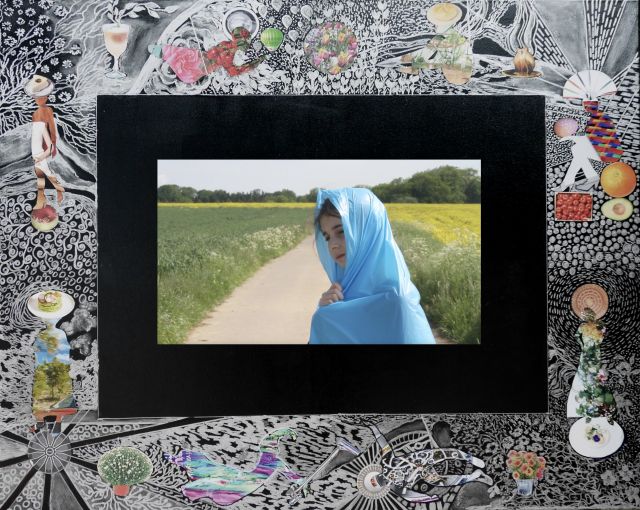
Every object in the sky looks like a star is the title of Irina Gabiani’s latest solo exhibition.
The title suggests a vision in which every object in the sky may appear as a star. This perception, however, reveals itself as unstable: what appears luminous and meaningful is often constructed, mediated, and accepted as real. The exhibition unfolds within this tension, reflecting on the processes through which images, symbols and narratives take shape and are internalized as truth.
Irina Gabiani’s latest body of work develops as a symbolic and politically conscious investigation into the mechanisms of power, illusion, and the construction of reality. The exhibition originates from the artist’s reflection on the political situation in Georgia. However, this starting point quickly expands into a broader, more universal dimension, where local tensions mirror a global condition, revealing mechanisms of power and authoritarianism on a planetary scale.
The exhibition opens with a video projection embedded within a hand-painted visual frame composed of collage, repeated patterns, and layered imagery. This painterly structure becomes an integral part of the narrative, dissolving the boundary between surface and depth, image, and object. The video shows a child, the artist’s daughter, walking across a yellow field, wearing a veil-like form made from a long plastic bag, which she drags behind her as a symbol of the future she inherits. The image becomes a silent allegory of inheritance: the ecological, social, and symbolic weight passed on to future generations by structures of power.
The exhibition culminates in two monumental works dedicated to the baobab, conceived as a vision of “before” and “after.” The first baobab appears dry and hollowed, constructed through collages of car wheels and images of protesting crowds, forming a collective body, a gesture of resistance and shared memory. The second appears lush but entirely artificial, composed of vegetal fragments and manipulated images of trees and rocks, revealing the constructed nature of an only apparent vitality.
Displaced animals inhabit the landscapes (We Are Not Your Zebras, We Are Not Your Flamingos, We Are Not Your Penguins), introducing a subtly unsettling presence that reflects the absurdity of controlled environments and imposed hierarchies. In We Are Not Your Trees and Precious Landscapes, nature is rewritten as a symbolic space where themes of control, excess, value, and spectacle emerge.
Through the fusion of collage, painting, and drawing, Gabiani constructs layered worlds in which illusion becomes both language and structure. The message remains essential and universal: neither nature nor people can be possessed. Power is fragile. Freedom exists only where resistance begins.